7 Signs Your Main Water Line Needs Replacing
Main lines rarely fail without warning. Here are the signs that point to the pipe between your meter and your house, and how to tell a one-time leak from a line that is worn out.
- By Diamond Bar Plumbers
- Published Nov 1, 2026
Your main water line is the single pipe that brings water from the meter to the house. It is buried, out of sight and easy to forget until something goes wrong. The good news is that most failing lines give you clues first. The trick is knowing which clues point to the main line and which point to a problem inside the house.
Below are the seven signs we see most often, roughly in the order homeowners notice them, followed by a simple test you can do yourself.
1. Low pressure at every fixture
Weak pressure at one faucet usually means a clogged aerator or a problem with that fixture. Weak pressure at every tap, shower and hose bib at the same time is different. It suggests something is restricting or losing water before it reaches the house, and the main line is the first suspect.
In older homes the cause is often corrosion. Galvanized steel narrows from the inside as rust builds up, so pressure fades slowly over years. In newer homes, a sudden drop is more likely a leak or a crack.
2. A water bill that keeps climbing
If your bill rises for two or three cycles in a row and nothing about your household has changed, water is probably going somewhere you cannot see. A buried leak can run around the clock without ever surfacing, especially in sandy or well-drained soil.
3. A meter that moves when nothing is on
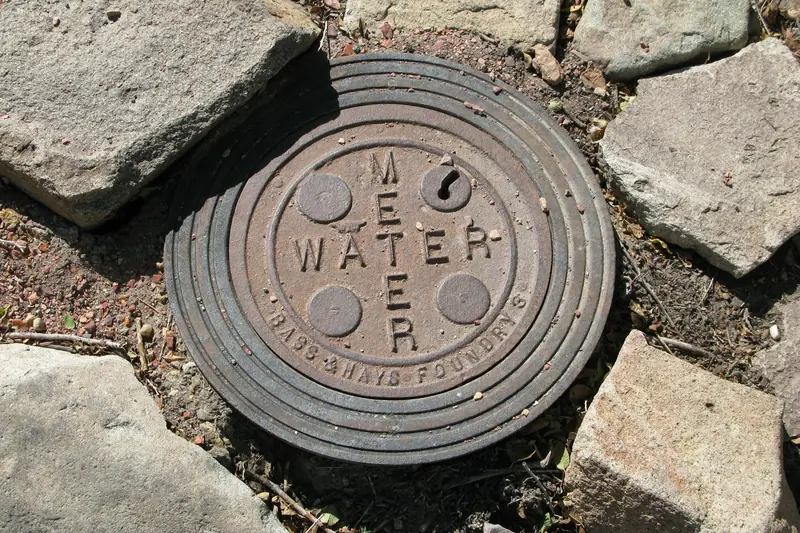
This is the clearest sign of a leak, and you can check it yourself. Walnut Valley Water District suggests turning off all water, reading the meter, and checking again later. If the sweep hand has moved or the reading has changed, you may have a leak. If toilets, irrigation and appliances are all ruled out, the main line becomes the likely culprit.
4. Wet spots or extra-green grass
A patch of lawn that stays soggy, or a strip of grass greener than the rest in the middle of summer, often traces the path of a leaking pipe. Water may also pool near the meter box or seep up between pavers along the line's route.
5. Rusty, brown or cloudy water
Discolored water at several taps, especially first thing in the morning, can mean rust is flaking off the inside of an old steel line. It is a common sign in homes that still have galvanized pipe, and it rarely improves on its own. Our guide to pipe materials explains why steel lines behave this way.
6. Sounds of running water
A faint hiss near the meter box, or the sound of water moving in a wall or under the floor when every fixture is off, means water is escaping somewhere under pressure. Listen at the meter and where the line enters the house.
7. Cracks, settling or a soft spot in the yard
Slow leaks wash out the soil around a pipe over time. That can show up as a sunken strip in the lawn, a new crack in a walkway or driveway, or a slab that seems to be settling. In hillside and clay soils this is worth taking seriously, since ground movement can damage pipes as well as being caused by them.
A quick test you can do today
- Turn off every fixture, the irrigation controller, the ice maker and anything else that uses water.
- Find your meter, usually in a box near the sidewalk, and note the reading or the position of the sweep hand.
- Wait at least 30 minutes without using any water.
- Check the meter again. Any movement means water is leaving the system somewhere.
- If the meter moves, close the main shutoff at the house and check once more. If it still moves, the leak is likely between the meter and the shutoff, which is the main line.
One sign or several?
A single sign, such as a wet spot after a hot spell, can be a one-time leak that a targeted repair fixes for good. Several signs together, or the same problem returning after a repair, usually means the line is worn out along its length. That is when replacing the line tends to make more sense than another patch.
Age matters too. Many homes around Diamond Bar, Walnut and West Covina were built decades ago, and lines from those years are reaching the end of their service life.
Signs that point somewhere else
Not every symptom is the main line. Low pressure at only the hot taps usually traces back to the water heater. A single dripping fixture is a fixture problem. A wet spot that appears only after the sprinklers run is often a broken irrigation line rather than the water service. Ruling these out first keeps you from digging in the wrong place.
What to do next
If you have run the meter test and it points to a leak, or you are seeing more than one of these signs, call us. We will ask a few questions about what you are seeing and the age of the home, and we can start with leak detection so any digging goes in the right place.
Questions about your main line? Call us.
A person answers 24/7, and same-day visits are available.