How Long Does Water Line Replacement Take?
Homeowners usually want to know two things: how long the whole job takes, and how long they will be without water. The answers are different, and both depend on your property.
- By Diamond Bar Plumbers
- Published Nov 1, 2026
A main line replacement is not one task. It is a short sequence of steps, some of which happen before anyone arrives with a shovel. Understanding the stages makes it easier to plan around the work.
Stage 1: Diagnosis and planning
Before replacing anything, the line has to be located and assessed. That means confirming where it runs from the meter to the house, what it is made of, what sits on top of it, and whether a repair could do the job instead. If there is an active leak, leak detection may come first.
For a straightforward property, this can happen in a single visit. Long runs, lines under hardscape or uncertain routes take longer to plan.
Stage 2: Permits
Water service work generally needs a permit. The City of Diamond Bar, for example, lists plumbing permits as required "for all plumbing work including water service" (City of Diamond Bar). Unincorporated communities such as Rowland Heights and Hacienda Heights go through Los Angeles County. How long a permit takes depends on the agency and its workload. Our permit guide has more detail.
In an emergency, the immediate goal is stopping the water and restoring service. Paperwork is handled as the local agency allows.
Stage 3: Marking utilities
Before digging, buried utilities such as gas, electric and communication lines need to be located and marked. In California this is done through the 811 call-before-you-dig system, which requires notice before excavation.
Stage 4: Trenching
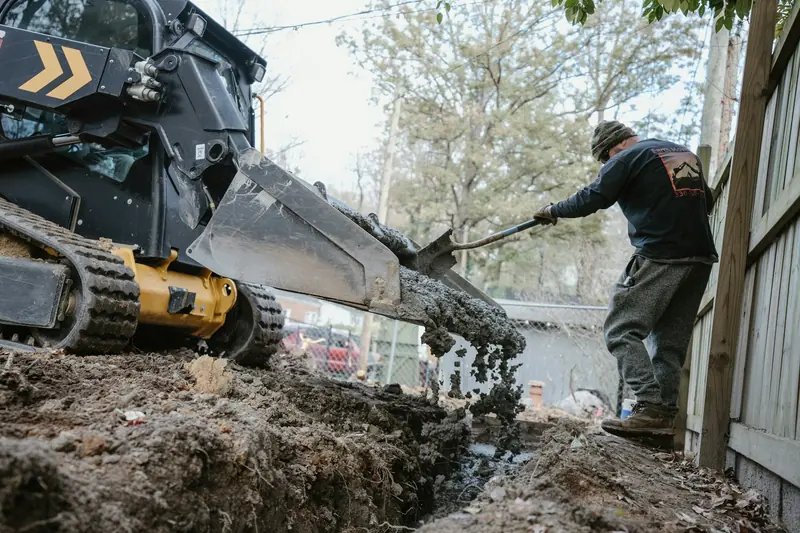
Digging is often the longest physical part of the job. How long it takes depends on:
- Length of the run. A house close to the street has a short trench; a house set far back has a long one.
- Soil and slope. Hard or rocky ground and steep lots slow things down.
- What is in the way. Tree roots, retaining walls, irrigation and other utilities need hand digging.
- Access. Narrow side yards may mean smaller equipment or more work by hand.
Our trenching page explains how we handle tight and sloped yards.
Stage 5: Installing and connecting the line
Laying new pipe in an open trench goes quickly. The connections at each end take more care. This is usually when the water is off, because the old line has to be disconnected and the new one tied in at both the meter side and the house.
Stage 6: Testing and inspection
The new line is pressure tested while the trench is still open, so any problem can be fixed before it is buried. Where a permit is involved, the inspector may need to see the line before backfill, which can add time depending on scheduling.
Stage 7: Backfill and restoration
The trench is filled in layers and compacted so it does not settle later. Topsoil goes back, and the surface is cleaned up. Replacing sod, plants or hardscape may happen separately.
How long will I be without water?
Usually much less time than the whole job takes. The water only needs to be off while the old line is disconnected and the new one is connected and tested. We tell you before we shut it off and give you an estimate based on your setup.
What makes a job take longer
- A long distance from the meter to the house.
- Lines under driveways, patios or the house itself.
- Hillside lots and retaining walls.
- Permit and inspection scheduling.
- Discovering problems once the ground is open, such as a second damaged section.
When the old route is the problem, rerouting can sometimes shorten the job by avoiding concrete altogether.
How to prepare for the work
- Fill a few pitchers or jugs of drinking water before the scheduled shutoff.
- Run the dishwasher and laundry ahead of time so you are not caught mid-cycle.
- Clear vehicles, outdoor furniture and anything stored along the line's route.
- Open gates and secure pets so the crew can move between the meter and the house.
- Mark sprinkler heads, low-voltage lighting and any private buried lines you know about.
- Let neighbors know if equipment will be parked on the street.
Emergency jobs follow a different order
When a line bursts, the sequence above gets compressed. The first goal is stopping the water, which may mean closing the main shutoff and isolating the break the same day. Restoring service comes next, sometimes with a temporary repair. A full replacement can then be planned, permitted and scheduled once the immediate problem is under control.
After the water comes back on, run each faucet for a minute to clear air from the pipes. Some sputtering and cloudy water at first is normal and should clear quickly.
Getting a realistic timeline
We do not quote a timeline over the phone without knowing the property, because the variables above change it so much. Call us, tell us about the house and the problem, and we will tell you what the job is likely to involve.
Questions about your main line? Call us.
A person answers 24/7, and same-day visits are available.